
LGBTQI+ refugees and asylum seekers celebrate Pride on UNHCR’s boat during the Amsterdam Pride © UNHCR
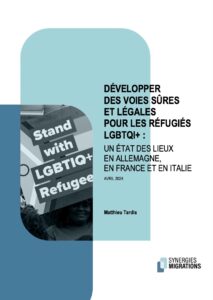
Unlike Canada, where programmes target this population, discussions about the inclusion of LGBTQI+ refugees on legal pathways are still at an early stage in the European Union while these mechanisms are growing and diversifying in Europe. This study aims to provide an overview of legal pathways for sexual and gender minorities in France, Germany and Italy. It aims to identify to what extent they are included in existing programmes, intentionally or otherwise, under what conditions, and whether there are more specific ad hoc practices for these refugees.
This study is based on a review of the literature and, above all, on interviews conducted between September 2023 and February 2024 with 20 representatives of organizations in Germany, France, and Italy, as well as in Brussels with European networks. It explores the various legal pathways that exist in Europe: resettlement, private sponsorship, humanitarian admission and family reunification.
The study shows that significant efforts are still needed to better include LGBTQI+ refugees in legal pathways programs in Germany, France, and Italy. However, there is growing awareness of this issue among the German and French governments, and especially among civil society organizations in all three countries. Capacity-building is needed, along with stronger cooperation between refugee support organizations and organizations advocating for sexual and gender minorities. Nevertheless, these efforts risk being ineffective without additional resources from public and private donors, and above all without the active involvement of LGBTQI+ communities in Germany, France, and Italy.
This publication is therefore an invitation to initiate a constructive dialogue among the various stakeholders (NGOs, LGBTQI+ communities, governments, local authorities, philanthropic foundations, UNHCR, etc.), with a view to experimenting with, evaluating, and structuring legal pathways for sexual and gender minorities at risk worldwide.
This publication was produced in cooperation with the Heinrich Böll Foundation Paris, France – Italy.

Our action

Activist Women in Exile
The Activist Women in Exile project (Femmes exiles engages – FEE) aims to develop a response tailored to the specific challenges faced by women changemakers forced into exile, and to support and raise the visibility of their socially driven initiatives. This experimental project is based on a collective dynamic: it is co-designed and implemented by several partner organizations, with the active participation of engaged exiled women and the support of an alliance of foundations.