
© Soledad André
While the United Nations High Commissioner for Refugees (UNHCR) estimates that 2.4 million people will need to be resettled in 2024, safe and legal pathways are more than ever key tools for refugee protection and for international solidarity with the countries that host the largest numbers of refugees. These mechanisms, which enable the regular and organized transfer of people in need of international protection, have shown a certain dynamism in Europe since 2015, though they still fall short of meeting global needs. Notably, there has been a rise in initiatives led by civil society organizations (NGOs, churches, universities, the private sector, etc.), contributing to the diversification of pathways to access European territory.
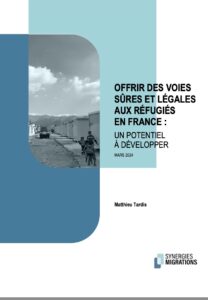 France has not remained on the sidelines of this movement. Government resettlement programs are being established in the country, with a target—confirmed at the Global Refugee Forum in December 2023—of 3,000 refugees per year. Alongside these governmental efforts, civil society organisations, citizen groups, and universities are mobilizing to propose complementary pathways for refugees in creative, though still limited, ways.
There is therefore a favourable environment for the development of legal pathways for refugees in France. However, this environment remains fragile in many respects. First, it is politically fragile. In the absence of a clear legal framework, legal pathways largely depend on the discretion of public authorities, with the exception of family reunification. The same applies to initiatives led by civil society actors, which cannot avoid cooperation with the government, at least for the issuance of visas and access to protection or residence in France. This is compounded by an uncertain economic model in a country where French and European public funding still strongly structures reception systems.
The aim of this brief is therefore to depict this evolving and diversifying French landscape of legal pathways, without overlooking the political, legal, and financial obstacles that hinder the consolidation of such programmes within the national protection system. It also seeks to demonstrate that these obstacles are not inevitable and can be overcome through better pooling of resources and expertise, as well as through the mobilization of new allies.
Download the report in English
Our action

Activist Women in Exile
The Activist Women in Exile project (Femmes exiles engages – FEE) aims to develop a response tailored to the specific challenges faced by women changemakers forced into exile, and to support and raise the visibility of their socially driven initiatives. This experimental project is based on a collective dynamic: it is co-designed and implemented by several partner organizations, with the active participation of engaged exiled women and the support of an alliance of foundations.